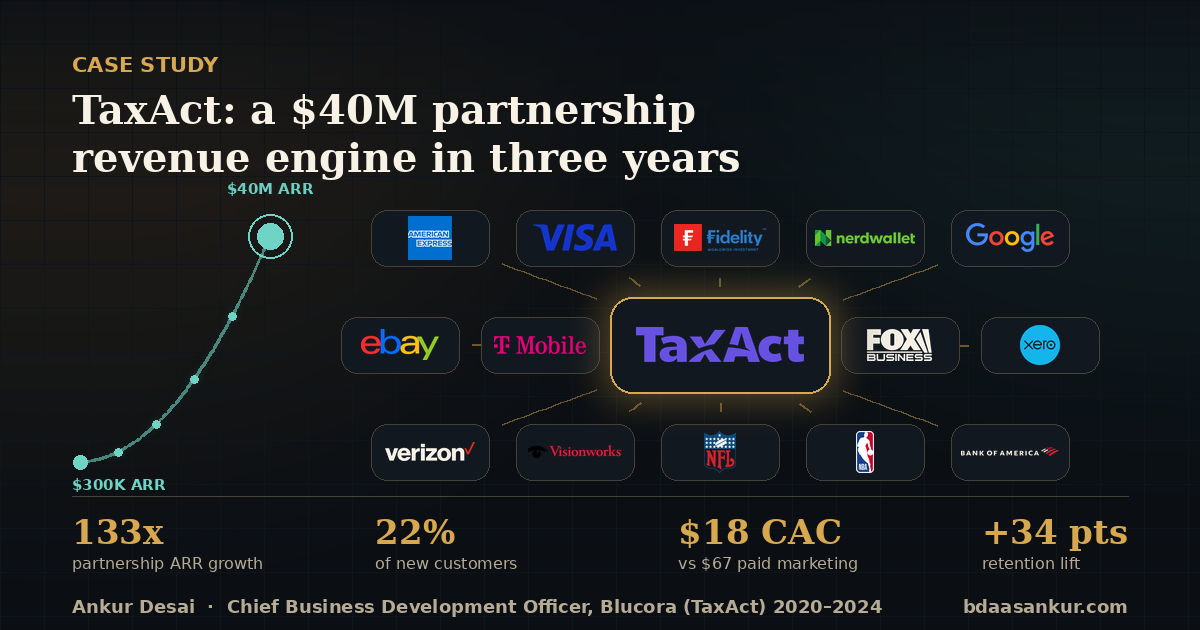
Most companies don't have a partnerships problem. They have a system problem.
Every partnership failure traces back to the same cause: no one built the system to execute it. I spent years inside BD functions diagnosing that gap across fintech, enterprise AI, and consumer tech until I stopped diagnosing and started building. The result is eight integrated modules covering every failure point from partner selection to C-suite narrative: the Partnership Revenue Operating System. I ran it myself: $40M ARR in 3.5 years, 54+ countries activated, partner CAC 3.7× more efficient than paid media. I now deploy it for companies ready to treat partnerships as a disciplined revenue function, not a relationship game.
$40M ARR
Partnership revenue scaled 133× in 3.5 years. Partnerships became the 2nd-largest revenue stream.
$18 vs $67
Partner CAC vs. Paid Media3.7× more efficient. 22% of all net-new customers sourced through the partner channel.
54+ Countries
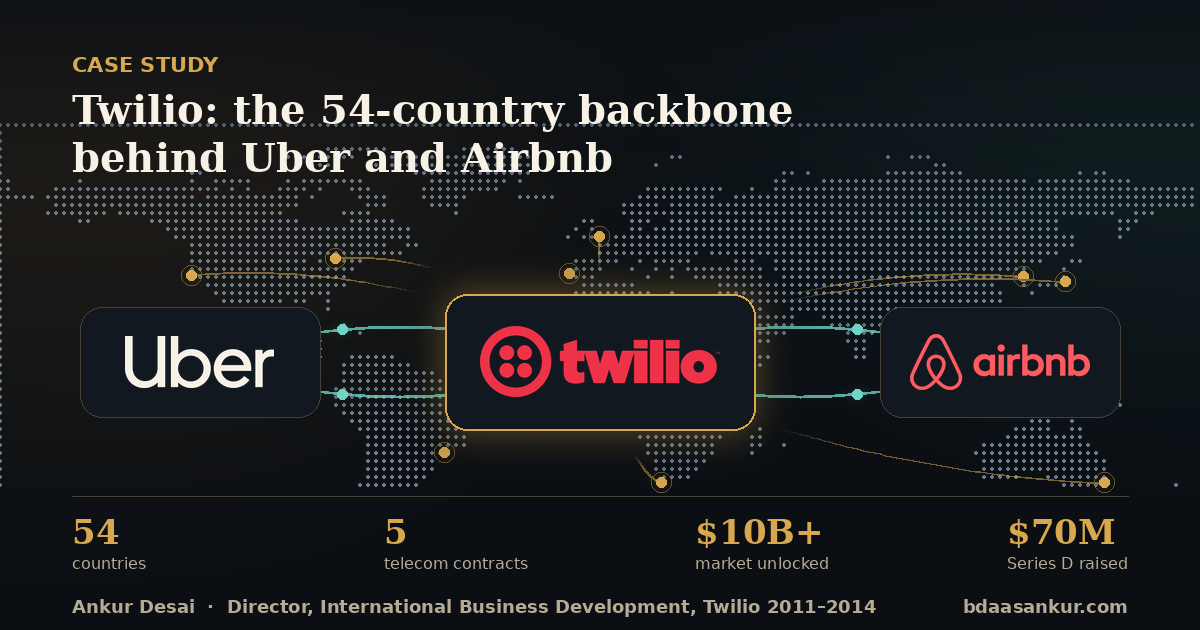
Global partnership architecture activated across 54+ countries, enabling a $10B+ revenue opportunity.

The Operator Behind the System
Ankur Desai
BD-led growth strategist. 15+ years scaling revenue across partnerships, GTM, and executive leadership at companies from early-stage startups to Fortune 500 ecosystems.
My background combines corporate finance discipline, GTM strategy, partnership execution, and cross-functional leadership. That combination matters because the most valuable growth problems rarely sit inside one department. They sit across strategy, economics, product, legal, and execution. I built the Partnership Revenue Operating System to solve exactly that. The frameworks aren't theoretical: every module maps directly to a failure mode I've diagnosed, worked through and solved in practice.
- $40M ARR via partnerships in 3.5 yrs
- $18 Partner CAC vs. $67 Paid Media
- 54+ Countries activated
- TaxAct / Blucora · Google · Amazon · eBay · PayPal
- Fintech · Enterprise AI · Retail Analytics
- C-suite BD & operating leadership
The eight modules
Eight integrated modules. Each one addresses a specific failure point in the partnership revenue cycle. Together they form a complete operating architecture: a sequential core and a modular support layer.
Modules 01–04 build on each other in order. Intelligence feeds the pitch. The pitch informs the deal. The deal structure shapes activation. Skipping or reordering this sequence produces predictable failure modes.
Partner Intelligence Engine
Identify and prioritize the partner opportunities that actually deserve executive attention before outreach begins.
Explore module →Partnership Pitch Framework
Build the business case from the partner's strategic perspective, not from your product roadmap.
Explore module →Deal Architecture
Design the commercial structure, ownership matrix, and risk allocation before the contract is drafted.
Explore module →GTM Integration Playbook
Translate a signed agreement into a live, producing revenue channel with joint positioning, enablement, and measurement.
Explore module →Modules 05–08 are not strictly sequential. Module 05 activates once the channel is live. Module 06 ideally precedes everything but can run at any stage. Module 07 should be built early and refined continuously. Module 08 overlays all eight modules. It is an operating layer, not a step.
Partnership CAC/LTV Model
Build the economic model that either confirms or disproves whether the partner channel deserves more investment.
Explore module →Ecosystem Mapping
Map the full commercial structure of your category and position your company at the points of highest leverage.
Explore module →Executive Narrative
Construct the strategic story that earns and sustains C-suite sponsorship through budget cycles.
Explore module →AI Acceleration
Apply AI purposefully across the full operating system: accelerating intelligence, monitoring deals, sensing ecosystem shifts.
Explore module →The operating system stays with me. What you receive is the output, applied to your company, your specific partners, and your growth context. The frameworks are not transferred; the results are.
Results this system is designed to produce
Shorter time to first revenue
Partnerships that are selected with intelligence, structured with discipline, and activated with a joint plan produce revenue faster than those that rely on relationship momentum and hope.
Fewer partnerships that stall after signing
The activation gap between a signed agreement and a producing channel is closed by Module 4 before it opens. Most BD teams discover it six months too late.
A channel budget that survives finance review
Modules 5 and 7 together build the economic model and the executive narrative that protect the partnership function during every budget cycle.
An operating system, not a list of tactics
The difference between a BD function that earns strategic credibility and one that stays perpetually tactical is almost always structural. This system provides the structure.
Why this is an operating system, not a framework
Sequential logic, not parallel advice
Each module connects to the ones before and after it. Partner intelligence feeds the pitch. The pitch informs the deal structure. The deal structure shapes GTM activation. The sequence is deliberate.
Mechanism over assertion
Every module is built around a decision logic, not a set of principles. It tells you not just what to do but what order to do it in, what criteria to apply, and what failure modes to anticipate.
Finance-literate by design
The system is built to survive scrutiny from a CFO, not just persuade a CEO. CAC, LTV, payback timelines, and risk-adjusted returns are built into the system, not bolted on at the end.
Designed to be deployed, not studied
Each module produces a specific output. Not insight. Not awareness. A decision, a document, a scorecard, a plan, or a narrative that changes what happens next.
How engagement works
There are three phases. Each one is structured, scoped, and priced clearly before anything begins. You are not signing up for an open-ended retainer or a vague advisory relationship.
Partnership Forensics
A structured diagnostic of your current partnership program against the full operating system. Identifies exactly which modules are missing, broken, or underperforming, and why. Produces a prioritized gap analysis, not a generic assessment.
Roadmap Delivery
A 30-day action roadmap built directly from the forensics findings. Module-by-module sequence, defined milestones, clear ownership, and the specific outputs each phase is designed to produce. Built for execution, not for filing.
Ongoing Execution
Fractional or retained engagement to implement the roadmap. I operate as an embedded partner, running the operating system, delivering module outputs, and building the partner channel toward measurable revenue contribution. Priced as a retainer with performance alignment.
Start with a 30-minute conversation. No cost, no commitment.
This is a high-level assessment. Not a sales call, not a free consulting session. In 30 minutes, you will understand which parts of your partnership program are structurally sound and which ones are likely costing you time, capital, or credibility. That conversation is useful whether or not we work together.
What happens after you submit: you will receive a response within one business day to schedule the 30-minute call. Come with a specific problem. That is when it is most useful.