Executive Summary
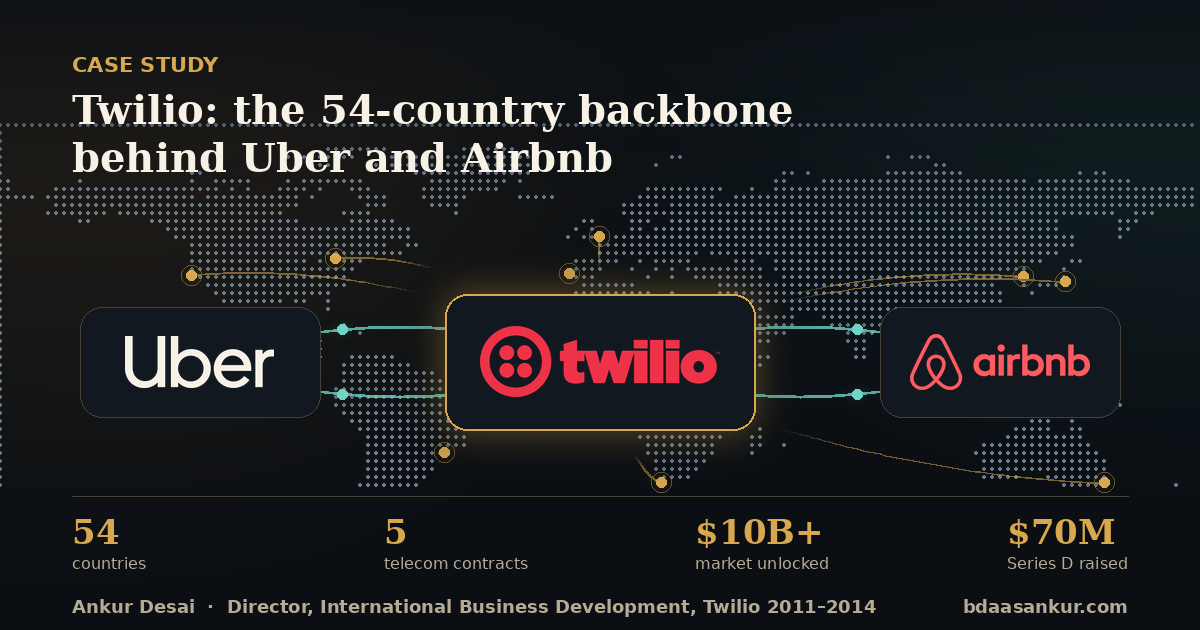
Between 2011 and 2014, Twilio needed to become a global platform before its customers went global without it. The blocker was not code. It was the telecom layer underneath the code: national carriers, number inventories, interconnect agreements, and regulators that operate one country at a time. This case study covers how five strategic telecom contracts, negotiated and structured as international infrastructure rather than vendor supply, extended Twilio's platform to 54 countries and formed the foundational building blocks of the Super Network. That footprint is what allowed Twilio to deliver Masked Calling and SMS at global scale, which solved a critical privacy, liability, and regulatory friction point for marketplace giants like Uber and Airbnb as they expanded across borders.
The Challenge
A US-native platform was facing global demand it could not yet serve:
- Global demand, domestic infrastructure: Twilio's developer-first API had product-market fit in the United States, but its customers were launching in London, Paris, Sao Paulo, Tokyo, and Sydney. Every new market required local phone numbers, carrier connectivity, and compliant provisioning that Twilio did not yet have.
- Telecom is a closed, sovereign market: International carriers do not sell to startups by default. Access to numbers and routes runs through Tier 1 operators with long procurement cycles, regulatory obligations, and little incentive to enable an API company that abstracts them away.
- Marketplaces cannot scale on personal phone numbers: Uber connects a driver and a rider who have never met. Airbnb connects a host and a guest who may be strangers on different continents. Exposing real phone numbers creates harassment risk, personal-data exposure, and direct liability for the platform in every jurisdiction it enters.
- Foreign regulatory constraints compounded the problem: Data protection regimes, telecom licensing rules, and consumer-privacy expectations differ by country. A privacy pattern that worked in San Francisco did not automatically clear the bar in the EU or Asia Pacific.
- Off-platform leakage threatened the business model: For Airbnb, once a host and guest exchange real contact details, the transaction can move off-platform. Disintermediation is a revenue problem, not just a trust problem.
The Solution
The work was framed as strategic infrastructure development, not international sales:
- Carrier deals as infrastructure, not procurement: Each contract was negotiated to cover multiple countries under a single agreement, with contractual durability and product roadmap alignment built in, so that five contracts delivered 54 countries instead of 54 separate negotiations.
- Expansion sequenced by customer demand and regulatory readiness: Prioritized regions where Twilio's fastest-growing customers were already launching, then structured coverage across Europe, Latin America, and Asia Pacific with Tier 1 operators and international interconnect providers, including Telefonica, KDDI, and Level 3.
- Deal terms structured for platform economics: Negotiated number inventory, routing, and commercial terms that let Twilio expose a single API across markets while the underlying carrier relationships remained invisible to the developer. This is the operating definition of the Super Network.
- Owned the cross-functional build, not just the signature: Aligned product, engineering, legal, and regulatory workstreams so that signed agreements went live as usable country coverage, with the compliance posture required in each market.
- Masked Communications made global: With local numbers and carrier routes in place across 54 countries, Twilio could provision temporary proxy numbers anywhere its customers operated. Uber could connect drivers and riders, and Airbnb could connect hosts and guests, without either party ever seeing a real phone number, keeping both platforms compliant and keeping the transaction on-platform.
- Expansion strategy converted into capital: Authored and delivered the global expansion strategy that anchored Twilio's next raise, contributing to the $70 million Series D closed in June 2013 and led by Redpoint Ventures alongside Bessemer Venture Partners and DFJ.
The Impact
The telecom backbone became the substrate for Twilio's global platform and for the marketplaces built on top of it.
54
Countries expanded into through five strategic telecom contracts, forming the foundational building blocks of Twilio's Super Network.
$10B+
New market opportunity unlocked for Twilio's platform as international coverage moved the addressable market from US-only to global.
$70M
New Series D funding secured on the strength of the global expansion strategy (June 2013, led by Redpoint Ventures).
450+
Global cities Uber scaled to, from its first international launch in Paris in December 2011, using the telecom backbone for anonymous, compliant driver-and-rider communication.
Downstream footprint: Airbnb scaled to more than 2 million listings across 191 countries by 2016, with hosts and guests communicating through temporary proxy numbers that protected privacy and kept transactions on-platform.